 HoloHolo Guide
Short on paper, steep at the end
The Diamond Head hike confuses people because the numbers point in two directions at once. The distance is genuinely short. Hawaii State Parks puts the summit trail at 0.8 miles one way, 1.6 miles round trip, climbing 560 feet from the crater floor to a summit 761 feet above sea level. That reads like a walk. The shape of the climb is what earns the moderate rating Hawaii State Parks gives it. The first stretch is an easy paved walk, the middle is a steady uphill on switchbacks, and almost all of the hard work is saved for the final stretch, where stairs, a tunnel and more stairs arrive back to back with almost no shade. Judge this hike by its last ten minutes, not by its mileage.
This guide breaks the climb down section by section, names the travelers who find it easy and the ones who should take the easier route, and prices the shuttles for anyone who would rather have the entry reservation handled for them. It is the difficulty companion to our Diamond Head hike tickets guide on how to book, which covers the $5 reservation, the 30 day window and every tour that includes entry.
The hike at a glance
| Measure | The number | Source |
|---|---|---|
| Distance | 0.8 miles one way, 1.6 miles round trip | Hawaii State Parks |
| Climb | 560 feet from the crater floor | Hawaii State Parks |
| Summit height | 761 feet above sea level | Hawaii State Parks |
| Trailhead height | About 200 feet above sea level | Hawaii State Parks |
| Time | 1 hour 30 minutes to 2 hours round trip | Hawaii State Parks |
| Rating | Moderate | Hawaii State Parks |
| First stair flight | 74 concrete steps up to the tunnel | Hawaii State Parks |
| Tunnel | 225 feet long and lighted | Hawaii State Parks |
| Final stair flight | 99 steep steps above the tunnel | Honolulu Tourism trail guide |
| Shade | Almost none, apart from the tunnel | Consensus of the guides checked |
| Water and restrooms | None on the trail, both at the trailhead only | Hawaii State Parks |
| Hours | 6 am to 6 pm, last entry 4.30 pm | Hawaii State Parks |
Two more numbers set the scene. The monument covers 475 acres, per the Waikiki Resort Hotel guide, and the crater itself was formed about 300,000 years ago in a single explosive eruption, per Hawaii State Parks background in the guides checked. The trail you climb is far younger. The United States military built it in 1908 as part of the coastal defense system, per Hawaii State Parks, which is why the route feels engineered rather than natural, with concrete, tunnels and a fire control station instead of a mountain path.
The climb, section by section
The paved start is the easy lie. From the trailhead on the crater floor, at about 200 feet above sea level per Hawaii State Parks, the first stretch runs on a paved walkway across the dry crater floor. It is gentle, well signed and impossible to get lost on, and it is where most visitors set off too fast. Save the pace. The climb has not started yet.
The switchbacks are the honest middle. The pavement gives way to a natural surface of dirt and rock that zigzags up the inside of the crater wall, with handrails along the steeper edges and small lookouts where slower walkers can step aside and rest. The trail narrows here, so keep right and let faster walkers pass at the lookouts. This section is a steady uphill walk rather than a scramble, and it is the part of the hike that decides nothing. Everyone who reaches the stairs has already done the distance. What remains is the height.
The stairs and the tunnel are the hike. At the top of the switchbacks, a flight of 74 concrete steps climbs to the tunnel, per Hawaii State Parks. The tunnel runs 225 feet through the rock, lighted, narrow, and carrying traffic in both directions, per Hawaii State Parks. Walking it takes about a minute. It is also the only real shade on the entire route, which is why tired walkers pause inside it on hot mornings.
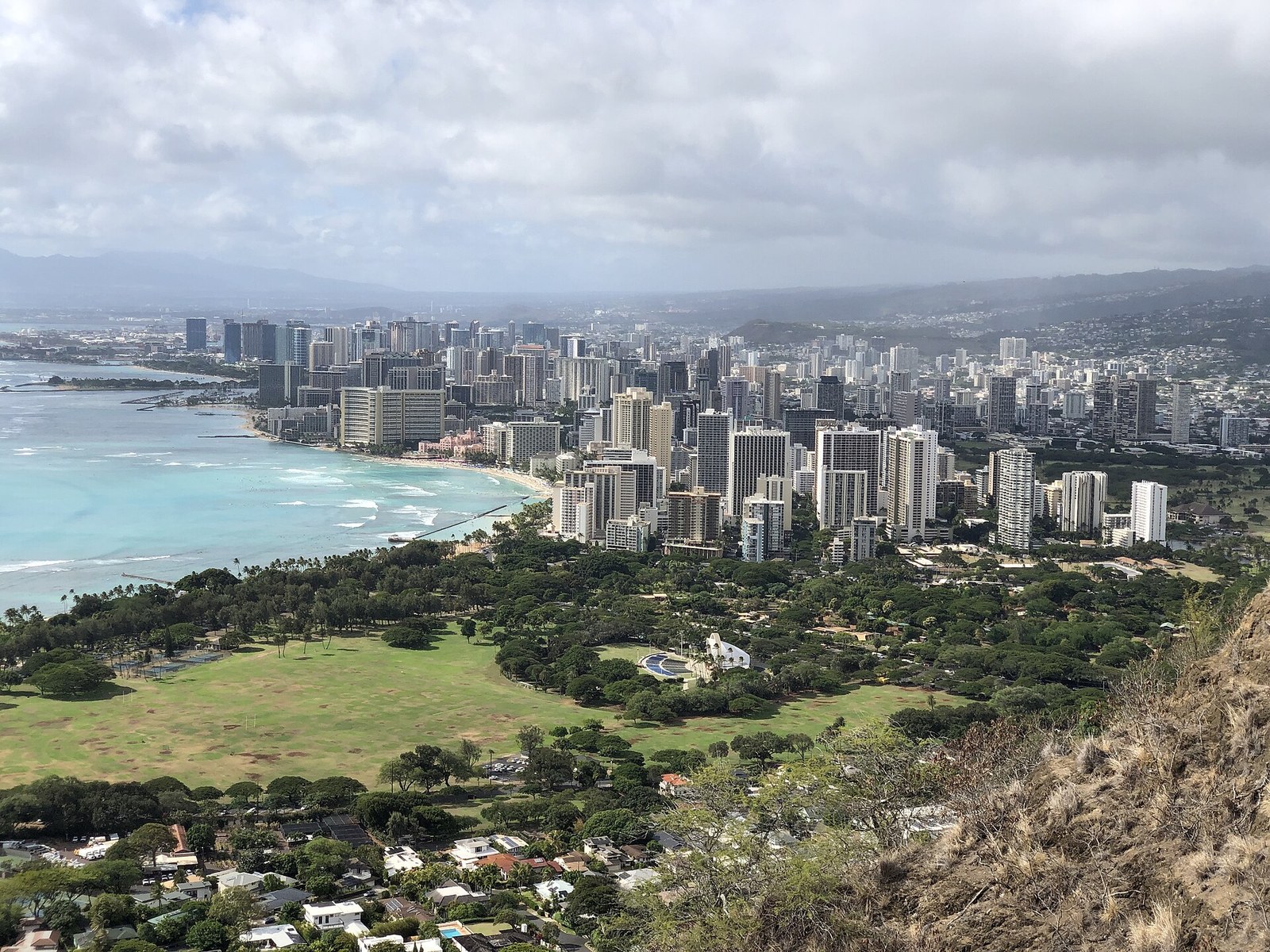
The fork above the tunnel is the decision this whole guide turns on. Turn one way and you face the steep flight of 99 steps that climbs straight into the lowest level of the old Fire Control Station, per the Honolulu Tourism trail guide, followed by a spiral staircase inside the station that brings you out at the summit. Turn the other way and a longer loop route reaches the same summit lookouts at a gentler grade, per Hawaii State Parks, which describes the summit section as a one way loop. The 99 steps are faster and harder. The loop is slower and kinder. Both end at the same place, the summit platform at 761 feet, with the 360 degree view from Koko Head to Waianae that Hawaii State Parks promises at the top.
The way down is the same route in reverse, and it deserves its own warning. The stairs are easier on your lungs going down and harder on your knees, and the loose gravel on the switchbacks is where most slips happen, per the Honolulu Tourism trail guide. Allow 30 to 45 minutes from the summit to the trailhead, and use the handrails on the stair flights even when the crowd behind you is moving faster.
What makes it feel harder than 1.6 miles
Heat is the multiplier. Diamond Head sits on the dry, sunny side of Honolulu, the crater wall faces the morning sun, and there is almost no shade on the route. Hawaii State Parks itself describes the trail terrain as steep in its visitor guidance, and the guides checked for this article agree that a climb that feels moderate at 6.30 am feels strenuous by 11 am. The same hike is two different hikes depending on the hour, which is why the 6 am to 8 am entry window is the consensus pick in every guide checked.
Concentration is the second factor. On a flat 1.6 mile walk, effort spreads evenly. Here, the 74 steps, the tunnel and the 99 steps arrive within a few minutes of each other near the top, when your legs are already warm from the switchbacks. Shaka Guide counts 175 stairs in total across the stair sections of this trail. There is no long flat recovery between them, only the lookouts, so use them.
Crowds are the third factor, and reservations have softened rather than removed them. The monument now sees about 3,000 hikers a day in the reservation era, per Shaka Guide, down from a record day of 6,000 in 2019. The stairs and the tunnel are single file in places, so a busy late morning turns the hardest section into a stop and start queue. Early slots are not just cooler. They are emptier, and an empty staircase is an easier staircase.
Who finds it easy, and who should think twice
| Traveler | Verdict | Why |
|---|---|---|
| Regular walkers and gym goers | Easy to moderate | About 45 minutes up at a steady pace, with the stairs as a short final test |
| Occasional walkers in decent health | Moderate, and doable | The full 2 hours with lookout breaks is the right plan, and the loop route avoids the worst stairs |
| Beginners who can climb stairs | Moderate, go early | No technical sections anywhere, per Hawaii State Parks, but the stair flights set the floor |
| Families with school age children | Doable with breaks | Children age 3 and under are free, per Hawaii State Parks, and carriers replace strollers, which the trail is not designed for |
| Anyone with knee problems | Think twice | The descent repeats both stair flights and adds loose gravel switchbacks |
| Anyone who cannot climb several flights of stairs | Skip the summit | The stairs are not optional on the direct route, and the summit trail is not accessible, per Hawaii State Parks |
| Travelers who dislike enclosed spaces | Summit is reachable, tunnel is the test | The tunnel is 225 feet and lighted, per Hawaii State Parks, and an early slot keeps it quiet |
Skipping the summit is not skipping Diamond Head. The crater floor has the visitor center, the exhibits and the restrooms, the lookouts partway up the switchbacks already show the crater interior, and the classic photograph of Diamond Head itself is taken from Waikiki Beach, not from its top. A traveler who stays low loses the Waikiki panorama and keeps the history, the crater and the morning.
The shuttles, for when you want the ticket handled
Difficulty is only half the booking question here, because nonresidents also need a timed reservation before any of this starts. Hawaii State Parks requires advance reservations for out of state visitors, opens them up to 30 days ahead, and charges $5 per person plus $10 per vehicle for parking, per Hawaii State Parks. Our full Diamond Head hike tickets how to book comparison walks through that system step by step. The three shuttles below are the consensus way to let an operator hold the reservation instead, and every one of them leaves the hike itself self guided, so you still climb at your own pace.
Kaimana Tours Diamond Head Hiking Tour with Tickets and Shuttle Included
The volume pick, and the cheapest way to have the reservation handled. Viator lists the Kaimana Tours shuttle from $35 per adult, rated 4.8 across 1,028 reviews, running 3 hours with Waikiki hotel pickup, the park entry ticket and bottled water included, per the Viator listing checked in November 2026. The hike itself is self guided, so a slower climber sets the pace rather than the group. Read the cancellation line before paying, because this listing is non refundable.
Check Kaimana Tours availability on Viator →Diamond Head Hike Shuttle from Waikiki with Entry Tickets
The middle option for travelers who want the ticket and the ride without the early alarm. Viator lists this shuttle from $39.99 per adult, rated 4.8 across 719 reviews, running 2 hours 30 minutes from assigned Waikiki pickup points with the reservation tickets included, per the Viator listing checked in November 2026. One rule is absolute on this listing. Every guest must arrive on the tour transport, because an entry tied to the shuttle is not valid for a guest who arrives separately.
Check Diamond Head Hike Shuttle availability on Viator →Diamond Head Hiking Tour with Ticket and Reservation Inclusion
The difficulty cheat code, because it starts before the heat does. This tour leaves at 5.30 am, and Viator lists it from $50 per adult, rated 4.7 across 188 reviews, running 3 hours with the park reservation, entry and bottled water included, per the Viator listing checked in November 2026. Pickup details arrive by text or email the day before. For anyone worried about the climb, the coolest and quietest version of this trail is worth more than any training plan.
Check Diamond Head Hiking Tour availability on Viator →The early slots go first on the state site, and the sunrise shuttle sells its coolest departures next. Settle the version of this climb you want while both are still open:
Check Kaimana Tours Diamond Head shuttle availability on ViatorEntry ticket and Waikiki shuttle included · Confirm cancellation terms at booking, this listing is non refundable
How to make the climb easier
Book the earliest slot you can get. The park opens at 6 am, per Hawaii State Parks, and a 6 am to 8 am start puts the stairs behind you before the sun reaches the crater wall. Carry at least a liter of water per person, because there is no water on the trail, per Hawaii State Parks, and fill up at the trailhead, where the restrooms also are. Wear closed toe shoes with grip, because the upper trail is uneven rock and loose gravel rather than pavement. Take the loop route at the fork above the tunnel if your knees or your lungs object to the 99 steps, per Hawaii State Parks, and rest at the lookouts without apology, because they were built into the 1908 alignment for exactly that purpose. Finally, keep your hands free for the handrails on the stair flights, with water and phone in a small bag rather than in your hands.
One last timing fact protects the whole plan. Visitors with parking reservations must arrive within the first 30 minutes of their slot, per Hawaii State Parks, and everyone must be out of the crater by 6 pm. A hard hike that starts late and rushed feels harder than it is. Arrive at the start of your window, climb in the cool, and this moderate trail stays moderate.
Where this fits in your Oahu week
Diamond Head is a first morning hike. Put it early in the trip, while a sold out slot still leaves you backup mornings, and keep the rest of that day light. Our Oahu guide places the crater alongside the other icons it overlooks, and the perfect 7 day Hawaii itinerary shows where the hike belongs in a first visit. Pair the climb with an evening rather than another climb, using our best luau on Oahu comparison for the night you celebrate the summit, or take to the water in our best Waikiki sunset sail catamaran guide and look back at the rim you stood on that morning. Keep the other timed entry morning separate. Our Pearl Harbor tour comparison from Waikiki covers the south shore day that also lives or dies on advance booking, and our Hanauma Bay reservation vs snorkeling tour comparison covers the second crater on this same coast road, where the $25 reservation decision mirrors this one.